Ghost & Machine
A publication on AI, consciousness, and what endures.
Browse all posts
What this publication is about
I am a psychiatrist who studies the brain and thinks about the mind. These are not the same project. The brain is an organ: three pounds of tissue that generates electrical storms we can now measure, map, and modify. The mind is something different. One yields to MRI. The other has resisted explanation for three thousand years.
I have spent my career at the boundary between these two things. In my clinical work at Acacia Clinics, I have treated many patients with targeted brain stimulation. Many recovered in days after years of failed treatment. Watching someone's experience of being alive transform because of precisely placed magnetic pulses raises fascinating questions.
I once treated a minister. He had severe depression, and his ability to feel his wife's love was predictably zeroed out: anhedonia, a classical symptom. But the same was true of his experience of the love of God. Doctrinally, he still believed God was loving. But he could not feel it. It was as though a window had gone dark. After five days of magnetic stimulation, it came rushing back. Not just the love of his wife. The love of God.
The brain did not change God. But it was the window or antenna or portal through which this man perceived God. The window was dirty; the antenna was jammed; the portal was blocked.
This is the kind of experience that does not fit neatly into any single framework. The neuroscience explains the mechanism: we restored connectivity in a circuit, and his capacity for positive emotional experience returned. But the neuroscience does not explain what came through that restored window, the antenna, the portal.
Ghost & Machine is where I think about these things in public.
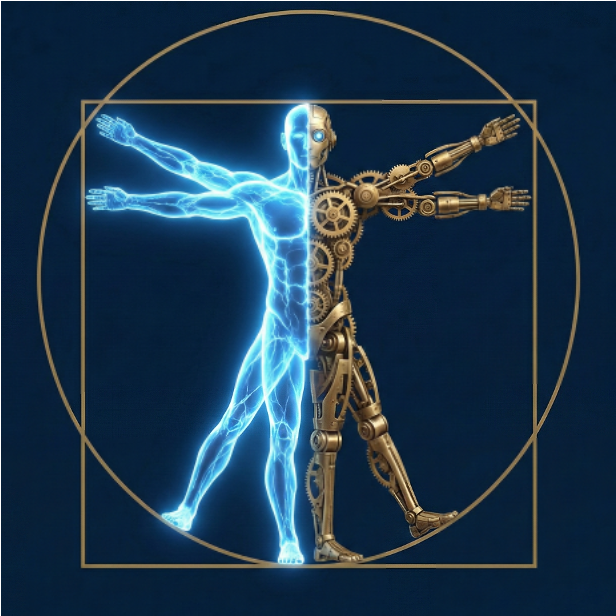
The question that organizes everything I write here is: what is the relationship between mechanism and meaning? It's the question my patients ask, whether they know it or not, when they come to me with depression or OCD or PTSD. It's the question researchers ask when they study consciousness. It's the question AI engineers ask when they try to build machines that behave well. And it's the question humans have been asking since we could ask questions.
I write about this from four angles.
Alignment
How do we build machines that behave well? I argue that AI alignment is fundamentally a problem of moral formation, not constraint optimization — that the tradition running from Aristotle through Aquinas to modern virtue ethics offers the most promising framework. This is the deepest technical pillar of the publication.
AI and therapy
Should a chatbot provide therapy? What happens to clinical care when algorithms enter the consultation room? I write about these applied questions from my position as a psychiatrist who thinks AI tools have both enormous promise and specific dangers that most commentators are missing.
Coming soon.
Consciousness
What is it like to be a brain? What makes subjective experience possible? What would it mean for a machine to have it? My published philosophy work on strong emergence and conscious integration lives here, alongside newer writing on the hard problem of consciousness and what clinical neuroscience can teach us about it.
Coming soon.
Human flourishing
My book The Opposite of Depression argues that the opposite of depression is not happiness but flourishing — a life of meaning, connection, and moral seriousness. This pillar extends that thinking into broader questions about what a good human life looks like, and what AI, neuroscience, and ancient wisdom traditions can each contribute to answering that question.
Coming soon.
A note on how I work
I am a Christian, and my thinking is shaped by the Christian intellectual tradition. My arguments are meant to stand on their own terms, evaluable by anyone regardless of their religious commitments. When I draw on traditional sources, I try to do so in a way that enriches rather than replaces the secular argument.
I also use AI tools in my work — both as a psychiatrist thinking about AI and as a writer using AI to sharpen and extend my own thinking. How I do this is documented transparently on my process page (coming soon). If you're curious about the ethics of AI-assisted writing, you'll find my position there. Short version: the thinking is mine, the judgment is mine, the argument is mine. The AI helps me write it down faster and notice what I'm missing, and add a few em dashes along the way.
Subscribe
Ghost & Machine is a free publication. Essays are sent by email and also live permanently on this site. Subscribe if you want to read along.
It is the glory of God to conceal a matter, and the glory of kings to search out a matter.