The Architecture of Joy
What Two Olympians Taught Me About the Fate of Humanity
Joy is one of the most sublime of human experiences. In Galatians, Paul lists it among the “fruit of the Spirit,” alongside love, patience, and self-control, as a mark of Spirit-formed life. Not an achievement but an outgrowth, the way an apple is the outgrowth of a tree that is doing what apple trees do. And yet joy is precisely the thing that appears to be dying on the vine.
Various flavors of doomerism fill the air: despair over the coming AI, the corruption in high places that never seems to result in prosecution, the economy (stupid). Antidepressants are now a normal part of the medical landscape in the United States. About one in seven adults reported using a prescription antidepressant in a recent survey period, a figure that would have been almost unimaginable when these drugs first came to market. Joy is not in abundance.
But the shortage is stranger than mere sadness. It is not that we have forgotten how to mourn. It is that we have forgotten how to stop mourning. There was a time, in healthier ages, when the calendar did the work for you: clear seasons of grief and clear seasons of celebration, a rhythm as old as Ecclesiastes (or the Byrds). A time to weep, and a time to laugh. The genius of the liturgical year, and of every good civic calendar, was that it gave you permission to do one thing at a time. You could be fully present to sorrow on Good Friday because Easter was coming. You could feast without guilt because the fast had been real.
We seem to have lost that rhythm. A gray fog, not quite depression, not quite despair, but a perpetual overcast, has settled over our celebrations. Those celebrating their own mothers do so with a visible asterisk on Mother’s Day, because not everyone has a mother. Those wanting to celebrate a promotion, or a vacation, or a healthy newborn baby are silently pressured to not be too happy about it because others who hear them might not have those things. Which is true. Of course it is true. But in a civilization that has lost the rhythm of mourning and feasting, the mourners do not get better comfort. They merely get the cold satisfaction of knowing that everyone else is a little less happy too.
But not at the Olympics. At the Olympics, the fog broke.
• • •
Two images from the Milano Cortina Olympics have been circling my mind ever since I saw them, and they will not leave.
The first is Alysa Liu, spinning free on the ice with a broad smile on her face, in bliss, as she does the thing that she is, by definition, the best in the world at. Olympic gold in women’s figure skating, ending a drought in the American program that had lasted long enough for people to forget what it looked like when it rained.
The second is Jack Hughes, who lost teeth to a high stick in the gold medal game against Canada and then came back to score the sudden-death overtime winner that delivered Team USA the gold. Bloodied and grinning. Or trying to grin, with what remained.
The one a picture of feminine grace: beauty, elegance, ecstasy. The other masculine and beaten and victorious. Both are pictures of triumph. Both are pictures of people who have learned what joy is. And I have been brooding, yes, truly brooding, over why these images pierced the fog when so little else does.
• • •
It struck me as I reflected on the pair: their jobs are secure.
I have been anxious about our future. What role do ordinary humans have in a world where AI is advancing rapidly, with no signs that we are hitting a ceiling and some signs that we are beginning an acceleration? I’ve written before about whether the coming intelligence will take the shape of a monolith or a mosaic, and I still believe the mosaic is the better hope. But the deeper question has been gnawing at me: What do we contribute that cannot be optimized away?
And I think the answer was on the ice.
We love watching other humans operate at the peak of their performance. We do not love watching accountants at the peak of theirs. We do not tune in to watch bankers. We appreciate the human stories behind programming or law, but we rarely watch people engaged in the technical act of their work. Sports are different because sports are whole-person events. The figure skater has to know where she is in space, her body tracking the angle of the spin, her eyes registering the ice and the blur of the crowd, her memory holding the choreography she has rehearsed ten thousand times. And then there is the thing that may have pushed Liu over the edge into ultimate victory: the sheer fullness of joy that was visibly coursing through her. Not just the perfection of the technical execution, not just the creativity, but the pure unadulterated joy she experienced on the ice, deep emotion pouring out through her movements so that even a viewer who knows nothing about figure skating could see it.
For hockey, add to all of that the presence of other minds: you have to model what the defender will do, plan three moves ahead, feint one way and cut another, all while absorbing punishing contact from players whose full-time job is to stop you. Everything happening at once. The brain and the body it is connected to, pushed to the absolute limit.
This is what we are built for. Not the narrow, efficient execution of a single optimized task (machines do that better already) but the whole thing. The feeling and the planning and the courage and the memory and the spatial awareness and the improvisation and the pain and the joy, fused together in a body that is hurtling across the ice at thirty miles per hour. No machine will replicate that. And even if one did, we would not care. We watch sports because we are watching one of our own do something we can barely imagine doing, and in their triumph, we participate. Their joy is our joy, received in diminished form but received all the same.
• • •
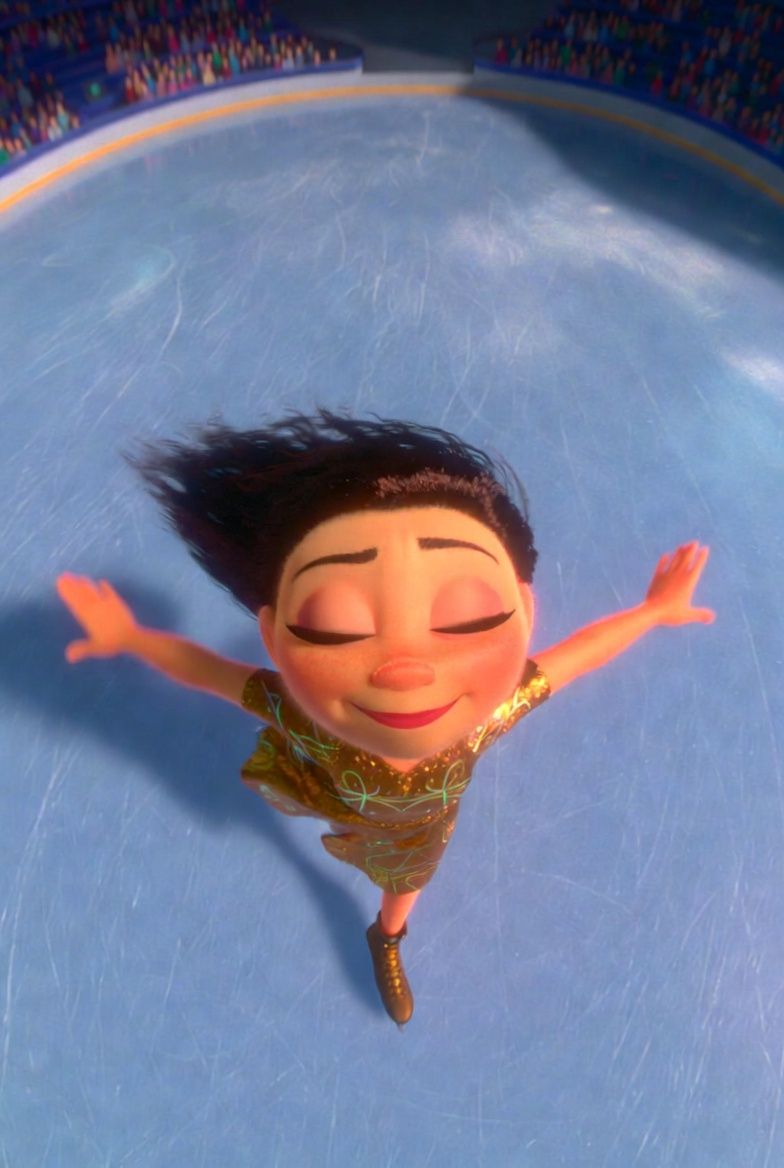
In one of my favorite films, Pixar’s Inside Out (perhaps unsurprisingly for a psychiatrist), there is a scene where the protagonist, Riley, recalls skating on a frozen Minnesota lake with her family. No competition. No stakes. Just a girl moving across the ice in freedom, the interior emotion Joy dancing alongside her in a way the animators rendered so beautifully it makes my heart ache. In the sequel, Inside Out 2, Anxiety seizes the controls during hockey tryouts, the fear of losing, the terror that her future is slipping away, and Riley becomes a clenched, desperate version of herself. The resolution comes when Joy returns, divine (literally?) sunlight pierces the darkness, and Riley stops performing and starts playing again, doing it for the pure love of the thing.
That trajectory, from compulsion to freedom, from anxiety to joy, is not only Riley’s story. It is Alysa Liu’s. Her father has estimated spending half a million to a million dollars on her training. Countless falls. Countless hours before dawn. And then she stepped away, burned out, the love of it gone. When she returned, it was different. She returned for the thing itself, not for the medal. And then the medal came anyway.
What if that is a picture of something larger than skating? Humans work, but what if we didn’t have to toil?
After Adam followed his wife into disobedience, Scripture says the ground itself was cursed: “Cursed is the ground for thy sake; in sorrow shalt thou eat of it all the days of thy life; Thorns also and thistles shall it bring forth to thee; and thou shalt eat the herb of the field; In the sweat of thy face shalt thou eat bread, till thou return unto the ground” (Genesis 3:17-19, KJV). Before the garden, their job was to tend the garden. They had work to do. But something about the punishment changed it, the same effort producing less, or producing something wrong, so that despite our best intentions the labor never quite yields what we meant it to yield. The ice is there, but now it is cold, and the falls hurt, and the thorns come up where we planted grain.
And yet. And yet. Two athletes rose above the thorns last month. Perhaps the technology, the skate, the stick, the arena, is not the enemy of the human but the instrument of the human’s freedom, the way an ice skate is not an obstacle to the dancer but the very thing that lets her fly.
• • •
As the film Chariots of Fire imagines Eric Liddell saying: “God made me fast, and when I run, I feel His pleasure.” This captures something about our species. There is a moment in competition, in running, in skating, in the full-body exertion of a human being doing the thing they were made to do, when transcendence breaks through. We hold a lighter or a cell phone flashlight up at a concert. We clap our hands. We pray on our knees or faces. We worship with arms raised. We are embodied creatures. Whatever happens in the future, whether or not we can upload our consciousness into the cloud, our species is and has always been embodied. The joy we feel is not some ethereal, disembodied abstraction. It runs through nerves and muscles and the wild electrochemistry of a brain that is, for one impossible moment, doing everything at once.
I know this is true because it happened to me.
I was a young medical student, bicycling back from class on a fall evening. Nothing remarkable about the night, nothing I had sought or planned. And unbidden, I began to sing Joy to the World in my head. As I sang, something shifted. The only way I can describe it is that the veil dropped, and I saw things as they really were. When the line came, and heaven and nature sing, nature truly did sing. The moon sang. The red brick rooftops sang. The trees and the sky sang. Tears of joy streamed down my face, and I was grateful. Grateful to God, who had created such wonderful things and placed me, like Adam in the garden, to enjoy them.
I did not earn that moment. I was not operating at the peak of anything. I was just a tired student on a bicycle. But joy came anyway, the way grace often does: unasked for, unsought, arriving on an ordinary evening like an unexpected visitor. Some of the most joyful moments in my life have been in worship. But that night was the most joyful of all. And it was given, not achieved.
As we build these machines, and we will build them, and they will be extraordinary, let us remind ourselves, and perhaps the machines too, that joy is a superpower. Not because it is useful, though it may be. Because it is valuable in itself. Let us use our ten fingers to play beautiful music and sing with our human voices, songs of old and songs of our new age. Let us seek joy. And create ever more moments, and minutes, and hours, and days where we can be full of it.
People sometimes ask (often ironically): What is the purpose of life? The question is impossible in some worldviews and leads to jokes in others (42). But for my own, the question can be answered straightforwardly. The Westminster Shorter Catechism gives: “Man’s chief end is to glorify God, and to enjoy Him forever.” Two jobs, but really one job. Glory, which is a kind of brightness. And Enjoy. In that relationship between God and man, we can experience joy most fully, not as an escape from the body but as the body’s highest expression. Not as a vacation from reality but as the deepest contact with it.
Whether we are at the beginning of the end of our species because the machines will rise and crush us, or whether this is the beginning of us as the joyous operators of infinitely capable machines, either way, the assignment does not change. Glorify and enjoy. Rise above the thorns. Seek the ice.
My four-year-old, Claire, while on the way to visit a family member last week, remarked to my wife from her car seat: “I love being in this life.” And my two-year-old, Josie, who cannot yet articulate the theology, knows it too, in the way that only a toddler can know something, with her whole body, before she has the words. She does a happy wiggle when things are going her way. This morning it was while eating oatmeal .
Two little children understand this better than I do. And perhaps this is part of what Jesus meant when he said, “Let the little children come to me and do not hinder them, for to such belongs the kingdom of heaven” (Matthew 19:14, ESV). Claire and Josie know something I have forgotten. They do not need a gold medal to feel it. They do not need to defeat the machines or solve the alignment problem or figure out the future of the species. Claire is riding in a car, looking out the window, and the world is luminous. Josie dancing with joy because of oatmeal.
I was on a bicycle once, on a fall evening, and the world was luminous too. I had just forgotten for a while. Let us all remember what we once knew.