How Psychiatry Finally Found the Brain

Notes from a Boston conference, two studies that landed on the same number, and the week my field finally stopped looking away from its own organ
I flew home from Boston this weekend with a feeling I had never had at this particular conference before. It is the strange and specific feeling of being early and right at the same time — in a room full of people who, after several years of polite skepticism, had come around to agreeing.
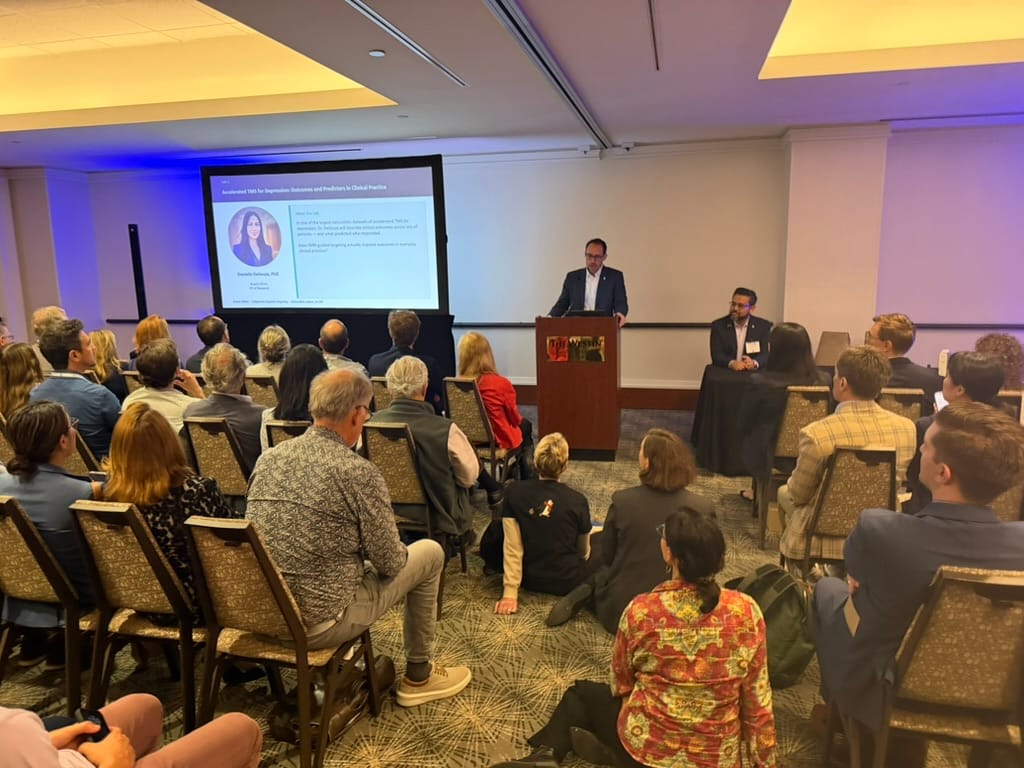
This past Friday I co-chaired a session at the Clinical TMS Society's annual meeting titled Personalizing Brain Stimulation in Real-World Practice: Targets, Biomarkers, and Clinical Impact. The room was full. People were standing along the walls, sitting on the floor, and spilling out into the hallway. Being popular felt good and on a base human level, I liked it. But I also liked it because of the C in Clinical TMS Society. The C stands for "Clinical." The people in that room were overwhelmingly practitioners — physicians who run actual clinics and treat actual patients. They are interested in one thing above all others: what works. To have that crowd press into the room was satisfying because it meant that at least some of them would change their practices and be more effective with their patients.
Several years ago, the work I am about to describe got us criticized — sometimes quietly, sometimes not so quietly. This year, the same work was no longer tolerated as an eccentric variant, but treated as forward-thinking leadership. And I hope that is what proves to be. But the more interesting story is not about me, or even about Acacia. It is about a century-old embarrassment in psychiatry and how it quietly ended this week.
Psychiatry is the only branch of medicine that ignores its organ.
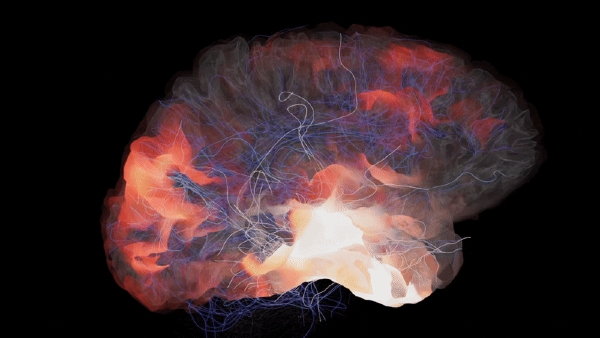
A cardiologist knows which artery. An orthopedist knows which bone. But for the better part of a hundred years, a psychiatrist did not have to know which circuit — and, more to the point, could not. We gestured at the brain the way a tour guide gestures at a famous cathedral from a boat on the far side of the river: close enough to point, never close enough to read the address over the door. We said the problem was "the serotonin," or "the dopamine." We pointed at lobes and regions with a confident sweep of the hand. But we were not actually being specific. We did not really have to understand what was wired to what, what switched on when you nudged it, what switched off. We treated the most complicated object in the known universe as if it were a weather system — too vast and turbulent to map, something you could only medicate in aggregate and hope.
The hand-waving was not laziness but the honest expression of how little we could see: not much.
So let me back up and tell you how I ended up co-chairing that session.
Here is a picture of me when I was young and spry.
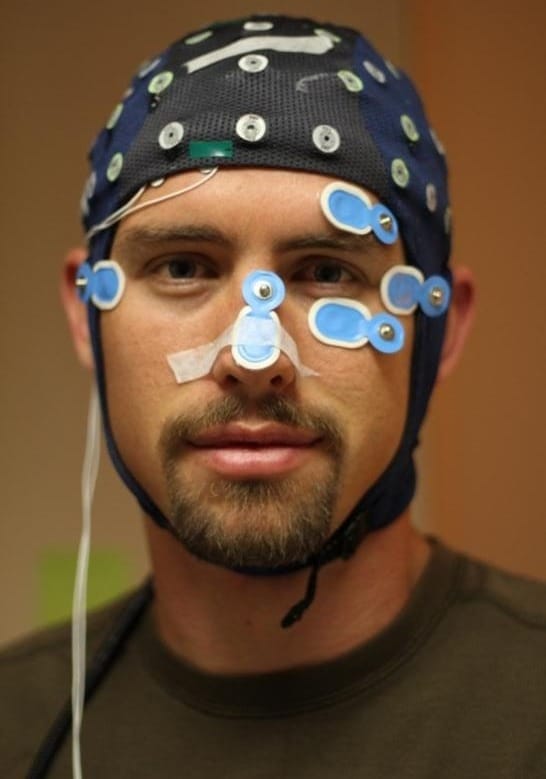
When I finished medical school at Stanford and started residency there, I was on track to be an academic psychiatrist. I had trained in the lab of the esteemed Amit Etkin, and thought that's how I would make the biggest impact on the world for the good. But about halfway through residency, I realized that academia, for all its virtues, was not going to be the fastest way to get the best treatments to the people who needed them.
I graduated residency in 2018 and I started Acacia Clinics with my good friend Nate Meng, whom I had met in medical school. We started it with one stubborn intention — to bring the best available treatment to patients — and we built the clinic outward from that. Soon after opening, we got a TMS machine.
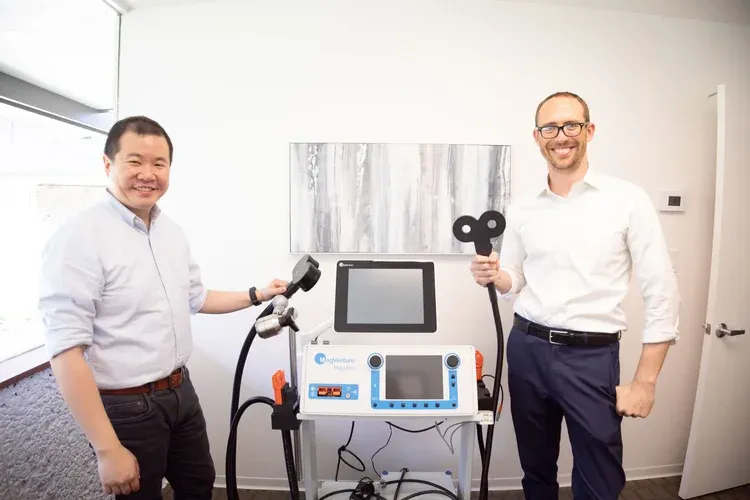
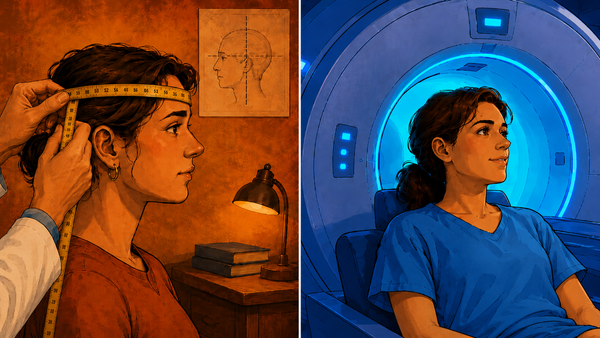
Soon after, we added fMRI neuronavigation, so that instead of placing the coil by tape-measure we could aim it using a map of each individual brain. By 2021 we were delivering fMRI-navigated TMS. At the time, SAINT was not yet commercially available, so we offered our own version of accelerated, navigated treatment. It was Holistic, Optimized, Personalized, Expedited TMS (HOPE-TMS).
We were among the first independent clinics in the country to work this way. Once word got out, people began flying in from all over the country and over a dozen countries to receive treatment. When the SAINT system itself was FDA-cleared in 2022 and reached the market, we became the first independent clinic in the country to offer it.
None of this looked obviously wise at the time. We had our intuitions, some preliminary science, and a growing number of patients whose lives had visibly changed in front of us. That was enough for us to believe in it. It was not, understandably, enough for everyone else. And I want to be fair to the skeptics, because their skepticism turned out to be the engine of the most interesting result I have to share.
The original SAINT trial — the randomized study I was fortunate to be part of the team on — was a genuine landmark. Nearly four out of five patients with severe, treatment-resistant depression reached remission, most of them within days. But it was built, by design, in a way that was celebrated by some and criticized by others: it changed several variables at the same time. It accelerated the schedule, packing multiple sessions into a day. It optimized the spacing between those sessions. It delivered a higher overall dose of stimulation. And it used fMRI to find a personalized target in each brain. Four ingredients, stirred together, producing a spectacular result.
Which left a perfectly fair question hanging in the air: which ingredient actually did the work? Maybe the whole effect was the higher dose, and the expensive brain imaging was a flourish. A serious scientist was right to ask.
So two groups set out, separately, to isolate the one variable everyone was arguing about — the imaging. Our colleagues at Harvard ran a smaller but more rigorous study, randomizing patients to accelerated treatment with fMRI navigation against accelerated treatment without it. At Acacia, we ran the same comparison on a much larger, real-world dataset. We did not coordinate. We simply both ran our analyses at around the same time. I was a believer. My colleague at Harvard, Joe Taylor, was doing the experiment expecting that fMRI didn't add that much. Both of us rigorously worked.
And we discovered something astonishing. Not only did both of us find that fMRI navigation beat non-navigated treatment — we found that it did so by nearly the same margin. Both of us landed on a difference of roughly twenty percentage points.
Two studies. One number. A large naturalistic dataset built in private practice and a small randomized trial run at a university — different methods, different patient populations, different institutions, no shared spreadsheet — converging on the same figure. The details of both reports are still being refined for final publication, and the numbers may move a point here or there. But the convergence is the thing. Because of the data we presented and saw presented, I now even more firmly believe that fMRI-guided targeting is not merely a good approach to treatment-resistant depression. It is the best one we have.
But the deepest reason that room was full has nothing to do with depression specifically. It is that anatomy has finally entered the picture. Psychiatrists want to believe, but this is the first time anatomy became compelling.
Consider what happened to the heart. A generation ago, cardiology was largely a field of medications and lifestyle counseling — manage the cholesterol, cut the salt, hope for the best (and the best wasn't that good). Then catheters and stents arrived, and everything reorganized. Suddenly you could navigate to the specific blocked artery and open it. The field stopped treating the cardiovascular system as a vague aggregate and started treating the disease where the disease lived. And over the decades that followed, age-adjusted deaths from heart disease fell dramatically. Interventional cardiology did not do all of that single-handedly; statins and a hundred other advances helped. But it transformed the field from one that medicated the whole system and hoped into one that went to the precise place and fixed it.
Interventional psychiatry is standing at exactly that hinge. Instead of medicating the entire brain and waiting weeks to see what happens, we are learning to navigate to the specific circuit and modulate it. And what made the Boston session electric was the evidence that this is not a one-condition trick. The same principle, applied across the map of psychiatric suffering, was on the program all day. Samantha Baldi of Harvard presented on using brain signals to select the right treatment in the first place. Andrew Pines, also of Harvard, presented on psychosis. My colleague Noah DeGaetano of Acacia shared are remarkable results in using fMRI guidance to help rescue people suffering from PTSD and OCD. And Danielle DeSouza of Acacia presented the comparison at the heart of this essay — fMRI versus non-fMRI targeting. The session was chaired by Shan Siddiqi of Harvard, one of the genuine leaders in network neuroscience, with me as co-chair. Harvard and Acacia, side by side on the same program, presenting the same idea applied to one disorder after another.
And here is the quiet revolution buried inside all of it: because we are finally being specific, the effects and the side effects we observe now map onto where we stimulate, or fail to stimulate. We are no longer guessing at a black box. We are reading a circuit diagram. That is what it means to follow the anatomy.
I want to end where the patients are.
My hope is plain. I want fMRI-guided targeting to become ordinary — available to everyone, not reserved for the sickest of the sick. I want brain maps, and whatever the next generation of neuroscience turns out to be, to inform more and more of what we do, for more and more conditions. I think we are at the beginning of what it will mean to practice psychiatry in the twenty-first century. I have some strong suspicions about where it goes from here, but that is a post for another day.
I also want to express gratitude toward the patients who trusted us before the science was settled. They sat in our chairs while colleagues elsewhere raised an eyebrow at what we were doing. For most of them, they got better — and they got better in a world where the evidence had not yet caught up to their recovery. As the science moves toward settled, what looked at the time like a leap of faith on their part looks, in retrospect, like foresight. They were right before the field was.
I'm also thinking about those who didn't get better, those patients who trusted us but didn't get better despite our best efforts. I wish that we could help everyone, and work for a world where that becomes closer to reality.
For a hundred years, psychiatry ignored the brain. This weekend, a room full of doctors paid very close attention. I am hopeful that ever more rooms are filled with ever more doctors learning the latest anatomy and bringing it back to their patients, drawing more and more people out of the darkness their brain holds them in.